Amanda Godbold

STRI postdoctoral FELLOW

As a conservation paleobiologist, my research focuses on understanding metacommunity dynamics and the factors influencing biodiversity across different spatial and temporal scales. I am particularly intrigued by how these patterns vary with scale, with a primary emphasis on reef ecosystems and the complex roles of corals and sponges. At the Smithsonian Tropical Research Institute (STRI), I am committed to revitalizing aspects of the Paleontological Database Project (PPP), leveraging this robust resource to explore community-level dynamics, such as the processes of community reassembly following disturbances caused by the emergence of the Isthmus of Panama.

Sven Pallacks

STRI FELLOW

Recently, I have completed my PhD at the Autonomous University of Barcelona in Spain. During my doctoral studies, I have investigated the effects of ocean warming, acidification and deoxygenation on the Mediterranean ecosystem, by reconstructing plankton and mesopelagic fish dynamics beyond the temporal scale of instrumental records. With the STRI short-term fellowship, I would like to build on my PhD research, and further investigate the impacts of ongoing ocean deoxygenation on mesopelagic fish energetics. To do so, I am using their otoliths (ear-stones) which accumulate on the seafloor after they die. Comparing otolith morphometry and chemistry from either site of the Isthmus of Panama allows me to determine if mesopelagic fish body size, growth and habitat depth is affected in oxygen deprived waters, such as the pronounced Oxygen Minimum Zone off the coast of Panama in the Pacific Ocean. My research is driven by a fascination of these tiny, often overlooked but incredibly important fish, as they play a vital role in ocean food webs, carbon cycling and sustaining aquacultures.

Andrew Sellers 

STRI FELLOW

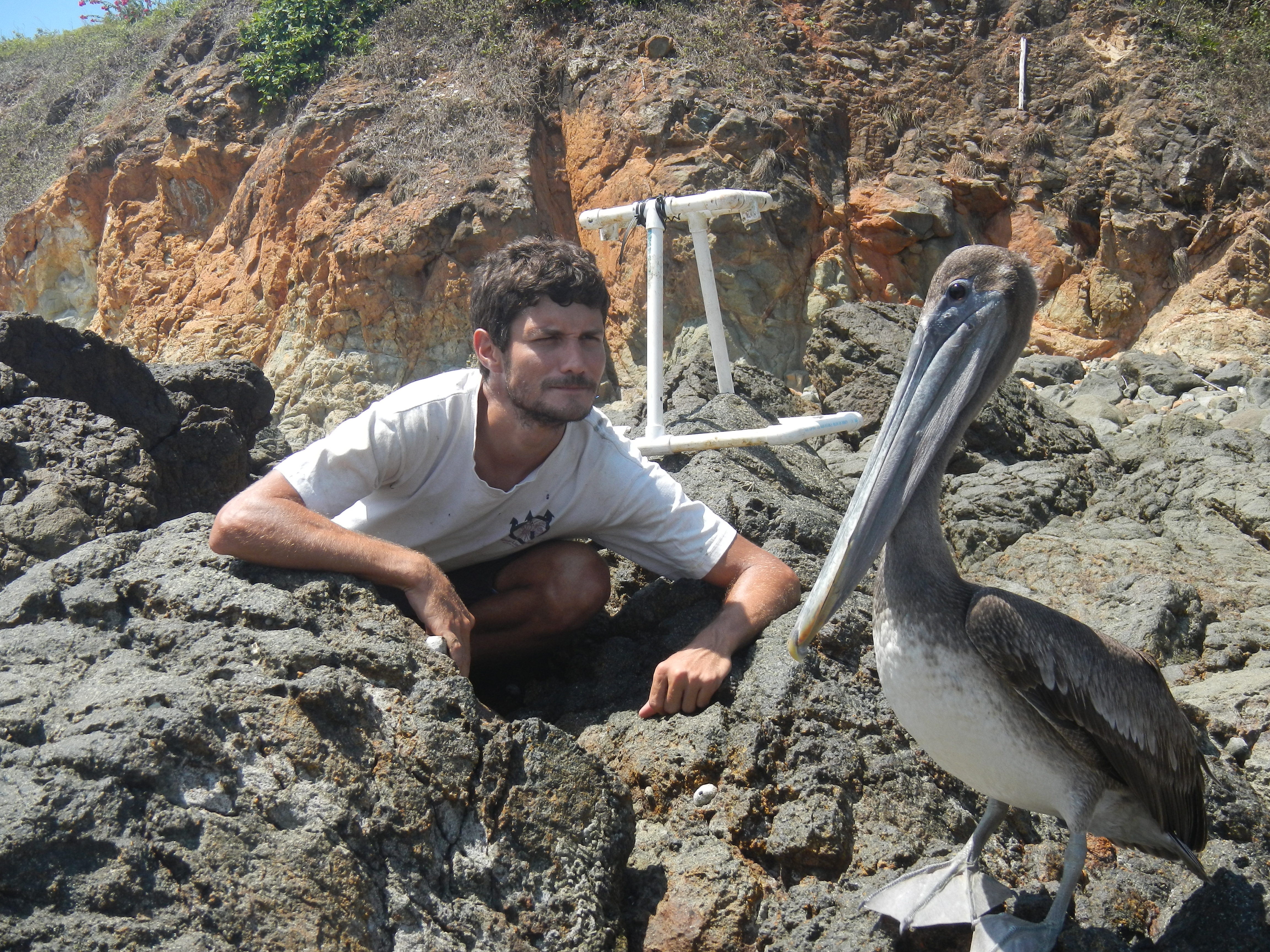
As a marine ecologist I study how marine predators and herbivores shape coastal ecosystems, and how those species interactions are influenced by changes in environmental conditions imposed by oceanographic processes. In particular, I focus on wind-driven upwelling events which allow the rise of cold, nutrient-rich water from the ocean’s depths to shallow coastal ecosystems. Seasonal variation in surface temperatures and food-availability generated by upwelling events can alter the strength of predation and herbivory. I rely on experimental manipulations of fish to study how consumer pressure on reef associated algae and sessile invertebrates varies along upwelling gradients along the Pacific coast of Panama and Costa Rica. My favorite animals is the pelican.  

Como ecólogo marino, estudio cómo los depredadores y herbívoros marinos dan forma a los ecosistemas costeros, y cómo esas interacciones entre especies se ven influenciadas por los cambios en las condiciones ambientales impuestas por los procesos oceanográficos. En particular, me centro en los fenómenos de surgencia impulsados ​​por el viento que permiten el ascenso de agua fría y rica en nutrientes desde las profundidades del océano hasta los ecosistemas costeros. La variación estacional en las temperaturas de la superficie y la disponibilidad de alimentos generada por los eventos de surgencias pueden alterar la fuerza de la depredación y la herbivoría. Me baso en manipulaciones experimentales de peces para estudiar cómo la presión de los consumidores sobre las algas e invertebrados sésiles asociados a los arrecifes varía a lo largo de los gradientes de surgencia a lo largo de la costa del Pacífico de Panamá y Costa Rica. Mi animal favorito es el pelícano.

Jorge Salgado

Post-doc (Now Professor at University College London)

IMG_1922

My research focuses in the understanding of multiple factors influencing freshwater biodiversity over time. I am interesting in the synergies between the introduction of exotic species, water pollution, hydrological alterations and climate change affecting lake assemblages in the Anthropocene. My work integrates paleolimnological techniques, historical data and contemporary monitoring data in human-impacted tropical lakes to:

  1. Assess how tropical lake communities respond over time (decadal to centennial) to environmental change (e.g. eutrophication, climate change and lake water level alterations).
  2. Determine if dominance of exotic aquatic plants and fish are a direct consequence of competitive exclusion with native species; or whether dominance is an indirect cause from direct negative effects of habitat disturbances on native communities.
  3. Explore if there have been positive impacts from the introduction of exotic species (e.g. carbon sequestration.

Mauro Lepore

maurolepore@gmail.com

Quantifying Ecological Changes in Reef-Building Corals over Historical Timescales

Coral reefs are declining worldwide but we do not know what a natural reef should look like because their degradation appears to have begun long beforeLeporeML_portrait_2 scientists began to survey reefs. Focusing on Bocas del Toro, Panama, this project aims to quantify the differences in the ecological structure of reef-building corals from a 7000 year old fossil reef versus a modern reefs. The fossil reef and modern reefs respectively developed before and during the period when human activity has been the dominant influence on climate and the environment. Understanding how reef-building corals have changed over historical timescales can help marine managers to assess the decline of Caribbean reefs relative to their condition before the period during which human activity has been the dominant influence on climate and the environment.